The AI Revolution in Nigeria: Local Languages and Edge Computing Driving Digital Inclusion
Discover how AI in local languages (Yoruba, Hausa, Igbo, Pidgin) and offline Edge Computing are transforming agriculture, commerce, and education in Nigeria.
S
Sarah ChenSenior Developer & Writer
14 min read2,747 words
Imagine a farmer in rural Kano State, standing miles away from the nearest cell tower, holding an inexpensive feature phone. Instead of navigating complex menus in a language he barely understands, he simply presses a button and speaks in fluent Hausa: "My tomato leaves have black spots, what should I do?" Instantly, a voice replies in the same dialect, diagnosing the blight and recommending a local, affordable remedy.
This isn't a futuristic concept sketched on a whiteboard in Silicon Valley; it is the reality currently unfolding across Nigeria.
For years, the promise of Artificial Intelligence (AI) has been constrained by two massive bottlenecks in the Global South: a heavy bias toward Western languages (predominantly English) and an absolute reliance on high-speed, constant cloud connectivity. In Nigeria—a nation boasting over 220 million people and more than 500 distinct languages—these bottlenecks have historically marginalized millions. The informal sector, which drives the bulk of the economy, has largely been locked out of the AI revolution.
However, a paradigm shift is underway. A powerful convergence of Local Language Natural Language Processing (NLP) and Edge Computing is fundamentally rewriting the rules of digital access. Major tech titans like Google and Microsoft, alongside a vibrant ecosystem of agile African startups, are building AI models that natively understand Yoruba, Igbo, Hausa, and Nigerian Pidgin. Crucially, through the deployment of Edge AI, these models are being engineered to run directly on devices, completely bypassing the need for constant internet connectivity.
This deep dive explores how the fusion of localized AI and edge computing is not just a technological upgrade, but a socio-economic lifeline—empowering market traders, farmers, and students, and establishing a new blueprint for digital inclusion across Africa.
Part 1: The Linguistic Divide in Artificial Intelligence
To understand the magnitude of local language AI, one must first understand the architecture of the digital divide.
The "English-First" Problem
Historically, the development of Large Language Models (LLMs) and voice assistants was heavily skewed toward English, Mandarin, and a handful of European languages. This wasn't necessarily born of malice, but of data availability. AI learns from the internet, and the internet is overwhelmingly English.
For a Nigerian user, interacting with early AI systems required speaking with a forced, unnatural "foreign" accent to be understood by voice-to-text engines, or typing in formal English—a barrier for the millions of Nigerians who communicate primarily in indigenous languages or Pidgin. If an AI system cannot understand the language a person dreams in, it cannot effectively serve them. This linguistic exclusion threatened to create a new tier of digital neo-colonialism, where the most powerful technological tools of the 21st century were only accessible to the urban, English-speaking elite.
The Complexity of Code-Switching
Building AI for Nigeria isn't as simple as translating English text to Yoruba. Nigerians naturally "code-switch." A single sentence spoken in a Lagos market might seamlessly blend English, Yoruba, and Pidgin: "I want to buy those shoes, but owo mi o pe (my money isn't complete), make we do transfer." Legacy AI systems break down when faced with code-switching. They require models trained on naturally mixed speech—the authentic way people actually converse on the streets of Lagos, Enugu, or Kaduna. Recognizing this gap, technologists realized that the next frontier of AI wasn't just making models bigger; it was making them culturally and linguistically contextual.
Part 2: Tech Titans and the Race for African NLP
Recognizing the immense untapped potential of the African market, global technology giants have aggressively accelerated their efforts to build inclusive AI frameworks.
Google's Multilingual Milestone
In early 2026, Google made a monumental leap in the Nigerian tech space by officially integrating Yoruba and Hausa into its AI-powered Search features, AI Overviews, and AI Mode. Powered by a custom, localized version of the Gemini model, this update allows users to ask complex questions and receive AI-generated summaries entirely in their mother tongues via text or voice.
According to Google's Communications and Public Affairs team in West Africa, this expansion was designed to ensure that "a student in Kano could ask questions in Hausa, while a trader in Ibadan could seek advice in Yorùbá." The integration goes far beyond rudimentary translation; it leverages advanced multimodal reasoning to understand local contexts, idioms, and cultural nuances.
Furthermore, Google's introduction of WAXAL—an open-source speech database developed in collaboration with African universities—has provided the foundational datasets required to train these sophisticated voice assistants, ensuring they recognize the unique cadence and tonal nature of African languages.
Microsoft and the Africa Development Centre (ADC)
Microsoft has equally doubled down on localizing AI. Through its Africa Development Centre (ADC) in Nigeria and Kenya, Microsoft has been nurturing homegrown engineering talent to build solutions tailored to the African reality.
Microsoft's investments in infrastructure, including its AI data centers, are heavily geared toward democratizing Natural Language Processing. By collaborating with local universities, innovation hubs, and initiatives like Data Science Nigeria (DSN), Microsoft is providing the computational power and cloud ecosystems necessary to train massive foundational models on African linguistic data.
Part 3: The Nigerian Startups Pioneering Afro-Centric AI
While big tech brings scale, local startups bring agility, hyper-local context, and an intimate understanding of the market's pain points. A new wave of Nigerian deep-tech startups is proving that the most effective AI for Africa must be built by Africans.
EqualyzAI: Voice-First Agentic AI
At the forefront of this movement is EqualyzAI, a startup explicitly dedicated to ensuring AI understands and communicates in African languages. EqualyzAI is building "Agentic AI" solutions—models that don't just transcribe text, but listen, reason, and act on behalf of the user.
What sets EqualyzAI apart is its approach to data. Through its DataCollect platform, the company ethically crowdsources hyper-local, multimodal datasets directly from native speakers. They train their models to handle the ubiquitous code-switching (English-Pidgin, Yoruba-English) that defines Nigerian communication.
More importantly, EqualyzAI is pioneering the development of the Afro-SLM (Small Language Model). Unlike massive LLMs that require server farms to run, Afro-SLMs are compact, highly focused models optimized for low-latency inference. They are designed to operate efficiently on the limited hardware typical of the African market, bringing advanced AI to feature phones and low-end smartphones.
Awarri and the LangEasy Initiative
Data scarcity is the biggest hurdle to training local AI. To combat this, platforms like Awarri have launched initiatives such as LangEasy. LangEasy acts as a crowdsourcing engine where Nigerians can record audio samples by translating English sentences into Yoruba, Hausa, Igbo, Pidgin, and Ibibio.
By actively engaging the community in the data collection process, Awarri is not only building a robust, high-quality dataset but is also ensuring that the diverse cultural heritage and distinct dialects across Nigeria are mathematically represented in the AI models of the future.
Intron Health: Specialized Clinical Speech
The application of local language AI extends deep into specialized sectors. Intron Health has developed clinical speech recognition tools fine-tuned specifically for African accents. Historically, global dictation tools like Nuance struggled significantly with Nigerian accents, forcing doctors to spend hours typing clinical notes.
By recording thousands of hours of African medical consultations, Intron Health created a model that boasts a 92% transcription accuracy rate for local accents, drastically reducing the administrative burden on healthcare professionals in Nigerian clinics.
Part 4: The Connectivity Chasm—Why Cloud AI Fails in Rural Nigeria
We have established that AI can now speak Nigerian languages. However, a massive structural barrier remains: Internet Connectivity.
Traditional AI, like ChatGPT or standard Google Assistant, is inherently cloud-dependent. When you ask a cloud-based AI a question, your voice is recorded, compressed, sent over the internet to a massive data center (often located in Europe or the US), processed by heavy servers, and the answer is beamed back to your phone.
This model works flawlessly in Lagos on a 5G network or a Starlink connection. But Nigeria's reality is deeply disparate.
The Infrastructure Reality
- Intermittent Connectivity: In rural areas, and even on the outskirts of major cities, 4G networks are highly unstable. Network dropouts are a daily reality.
- Latency: The "round trip" time for data to travel from a farm in Benue State to a server in Dublin and back can result in frustrating delays, making real-time voice conversations with AI impossible.
- Data Costs: For a market trader operating on razor-thin margins, the sheer cost of mobile data required to continuously stream audio to the cloud is economically unviable.
If the goal of local language AI is true digital inclusion, relying on a cloud-only architecture ensures that the technology will fail exactly where it is needed most. This is where the magic of Edge Computing comes in.
Part 5: Edge Computing—The Unsung Hero of African AI
Edge AI is the integration of artificial intelligence with edge computing. Instead of sending data across the ocean to a centralized cloud server, the AI data processing, reasoning, and decision-making happen at the edge of the network—meaning directly on the user's smartphone, feature phone, or a local IoT device.
How Does Edge AI Actually Work?
To fit an "Artificial Brain" inside a $50 smartphone without an internet connection requires brilliant software engineering. It is achieved through several advanced techniques:
- Small Language Models (SLMs): Instead of using a trillion-parameter LLM that knows everything from quantum physics to Shakespeare, developers create SLMs tailored to specific tasks. An agricultural SLM only knows about crops, weather, and localized farming techniques. Because it is highly focused, the model's file size is drastically reduced.
- Model Quantization and Pruning: Engineers compress the AI model by reducing the mathematical precision of its neural networks (quantization) and removing connections that aren't strictly necessary (pruning). This allows a model that originally required 10GB of RAM to run perfectly on a device with just 1GB of RAM.
- Neural Processing Units (NPUs): Modern mobile processors, even budget ones, are increasingly equipped with NPUs—specialized hardware designed specifically to run AI calculations quickly and without draining the battery.
The Benefits of Edge AI in the Nigerian Context
- Zero Latency: Because the processing happens locally, responses are instantaneous.
- Offline Functionality: The AI works flawlessly during network outages or deep in rural areas with zero cell reception.
- Cost Efficiency: No data is transmitted, saving the user money on mobile data plans.
- Privacy: For sensitive queries (like health symptoms or financial bookkeeping), the data never leaves the user's device, ensuring total privacy.
Part 6: Real-World Impact: Transforming Livelihoods
When you combine AI that speaks the local language with Edge computing that doesn't require the internet, the impact on Nigeria's socio-economic landscape is nothing short of revolutionary. Let's examine the transformation across three critical sectors.
1. Empowering the Agricultural Backbone (Farmers)
Agriculture remains a cornerstone of the Nigerian economy, employing millions. However, most smallholder farmers operate in rural areas with poor connectivity and rely on traditional, often outdated farming methods.
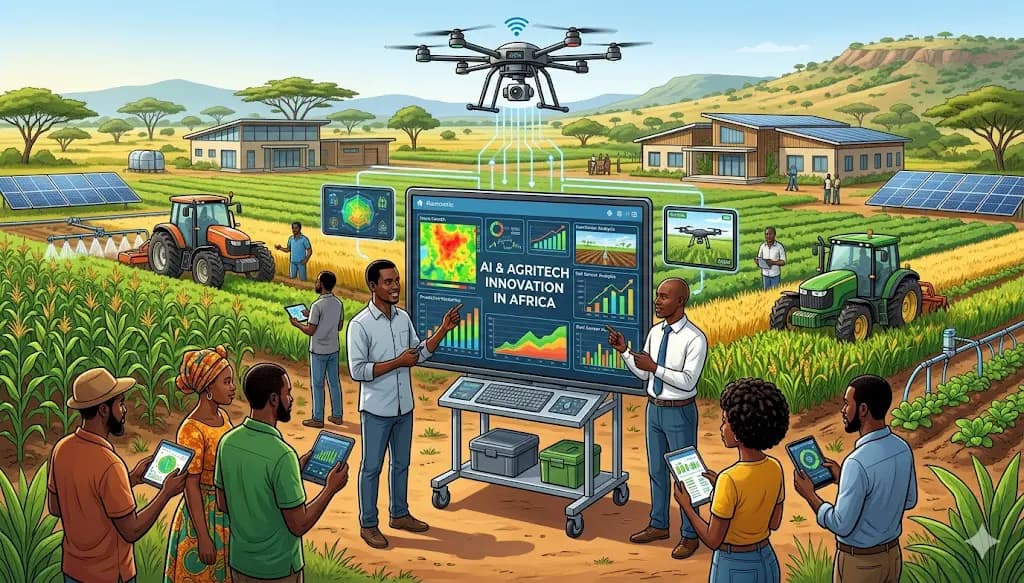
The Edge AI Intervention: AgriTech startups are deploying Edge AI systems directly into the fields. Imagine a locally deployed gateway or a basic smartphone app running an offline AI model.
- Crop Disease Diagnostics: A farmer in Enugu spots a strange discoloration on her cassava plants. She opens an offline app, points her phone's camera at the leaf, and the Edge AI instantly processes the image. It identifies the disease and, using a local Igbo voice assistant, speaks out the exact steps she needs to take to save her crop.
- Precision Agriculture: IoT sensors placed in the soil measure moisture and nutrient levels. An edge device processes this data locally. If the soil is too dry, it doesn't wait for a cloud connection; it triggers a local alarm or sends an SMS in Hausa to the farmer advising immediate irrigation. This precise, offline resource management leads to drastically improved crop yields and water conservation.
2. Revolutionizing Commerce (Market Traders)
The informal sector—characterized by bustling open-air markets, street vendors, and micro-entrepreneurs—is the lifeblood of Nigerian commerce. Many of these traders have low formal literacy, making traditional accounting apps useless.
The Edge AI Intervention:
- Voice-Activated Bookkeeping: A market woman selling textiles in Balogun Market no longer needs a ledger book. Using an app powered by an offline SLM, she simply speaks to her phone: "I don sell three wrappers for 15,000 Naira to Iya Tope." The Edge AI understands her Yoruba/Pidgin mix, transcribes the audio locally, and automatically updates her digital inventory and sales records.
- Digitizing the Tontine (Ajo/Esusu): Traditional communal savings circles (Ajo or Esusu) rely heavily on trust, oral agreements, and physical cash. New FinTech applications are digitizing these systems using voice-first AI. A trader can verify her daily contribution to the thrift collector via a voice note. The local AI verifies the speaker's identity and updates the ledger, bringing the massive informal financial flows into the digital era without assuming high literacy or constant connectivity.
3. Democratizing Education (Students)
Nigeria faces a significant educational challenge, with millions of out-of-school children and classrooms that are often overcrowded. A major barrier to learning is that the curriculum is taught in English, which may not be the student's primary language.
The Edge AI Intervention:
- Offline Smart Tutors: Educational tablets pre-loaded with Edge AI can act as personalized tutors. A child in a remote village can interact with a math application that explains fractions not in abstract English, but in familiar Pidgin or Hausa.
- Interactive Learning: Because the AI runs locally, the tablet can instantly correct pronunciation, grade oral quizzes, and adapt the lesson plan to the child's learning speed, all without requiring the school to have a broadband connection. This bridges the educational divide, proving that literacy in a foreign language should not be a prerequisite for acquiring knowledge.
4. Healthcare and Crisis Management
In rural clinics, where doctors and nurses are chronically understaffed and internet is a luxury, Edge AI is a lifesaver. Offline symptom checkers that allow patients to describe their ailments in local dialects can help triage patients before they see a nurse. Furthermore, local edge devices monitoring community health data can flag anomalies (like a sudden spike in malaria symptoms in a specific village) and store the data, forwarding it to national health databases the moment a connection is re-established (a process known as store-and-forward transmission).
Part 7: The Road Ahead—Challenges and Ecosystem Building
While the trajectory is incredibly promising, scaling Local Language Edge AI in Nigeria is not without its hurdles. To fully realize this vision, several challenges must be systematically addressed.
The Hardware Constraint
While Edge AI makes software lightweight, it still requires capable hardware. The average cost of a smartphone with a competent NPU is still prohibitive for the lowest-income brackets. Startups and hardware manufacturers must collaborate to build ultra-affordable "AI-first" feature phones.
Continuous Data Refinement
Language is alive; it evolves constantly. Slang used in Lagos today will change tomorrow. AI models must be continuously updated to reflect these linguistic shifts. This requires ongoing, ethical data collection and mechanisms for edge devices to occasionally sync with the cloud to receive updated, compressed models (Federated Learning) without compromising user privacy.
Policy and Government Strategy
The Nigerian government has a critical role to play. Initiatives like the 3 Million Technical Talent (3MTT) program are already building the human capital needed to sustain this tech ecosystem. However, policy frameworks must be enacted to encourage the localized hosting of data, provide grants for deep-tech AI research at local universities, and incentivize the deployment of AI in agriculture and education. The National Information Technology Development Agency (NITDA) must champion "AI Sovereignty"—ensuring that the algorithms shaping the nation's future are deeply rooted in its cultural context.
Conclusion: A Blueprint for the Global South
The integration of Local Language AI and Edge Computing in Nigeria is far more than a technological novelty; it is a profound instrument of socio-economic empowerment. By stripping away the prerequisites of English proficiency and broadband internet, innovators are unlocking the potential of the informal economy, revolutionizing rural agriculture, and making education genuinely accessible.
As Google, Microsoft, and trailblazing startups like EqualyzAI and Intron Health continue to push the boundaries of what is possible, Nigeria is positioning itself as the ultimate proving ground for inclusive technology.
The message echoing from the markets of Lagos to the farms of Kano is clear: The future of artificial intelligence does not just reside in the pristine server farms of Silicon Valley. It lives on the edge, it speaks Yoruba, Hausa, Igbo, and Pidgin, and it is ready to serve the next billion users on their own terms.